


Introduction
i. INTRODUCTION
Section titled “i. INTRODUCTION” { width=“200”, align=center }
i. Purpose
Section titled “i. Purpose”Imagine that your role is to both know the expectations of City residents and explain them to people new to the community. How would you begin to organize current issues, or estimate future needs? One method is to divide issues into separate areas and write down basic “goals” with explanations. Once completed, the document would be reviewed by the community as a whole and “adopted” as the plan for the City. The document would be used daily by staff in recommending changes to the City and periodically reviewed. Although greatly simplified, the above explains both what the General Plan is, and how it is used.
The General Plan is referred to often by City officials, and by prospective developers. The document both explains what the community expects from new development, and where the development should occur. Goals in the General Plan help the Council in seeking grants and moving the community forward.
i.1. Physical Description & Location
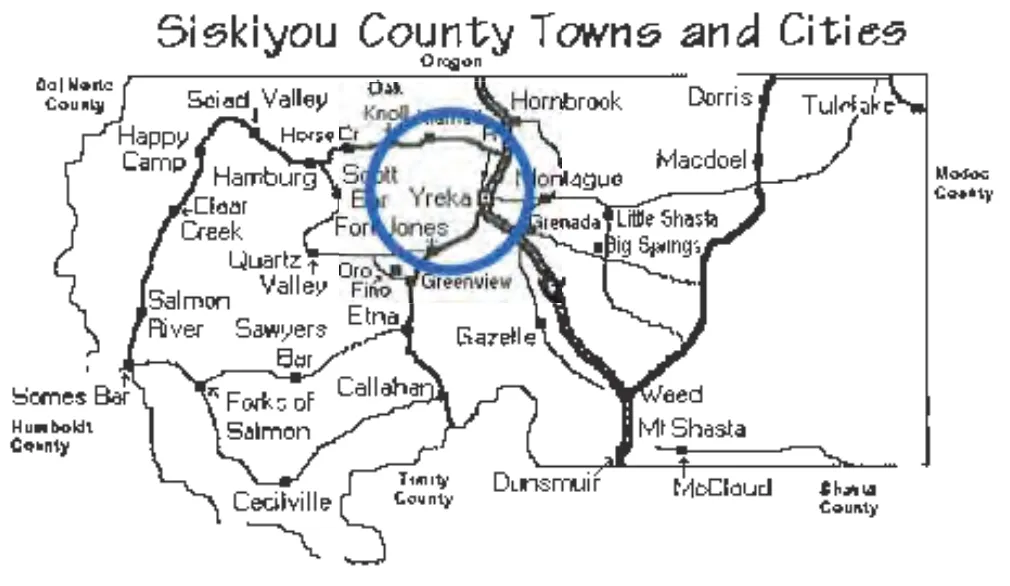
Section titled “i.1. Physical Description & Location”The City of Yreka is located in Siskiyou County in Northern California, and serves as the County seat. Located approximately 22 miles south of the California–Oregon border in the Shasta Valley, Yreka encompasses approximately 9.97 square miles and is situated along Interstate 5 (see Figure 01). The Bureau of Land Management (BLM) or private land surrounds the City with the Shasta Valley to the east and the Kilgore Hills to the southeast. The population of Siskiyou County is approximately 44,301, with 7,290 residents within the City of Yreka.
LEGAL BASIS & REQUIREMENTS OF THE GENERAL PLAN
Section titled “LEGAL BASIS & REQUIREMENTS OF THE GENERAL PLAN”California state law requires that every city and county adopt a general plan to guide physical development of the land within the jurisdictions’ boundaries. The plan acts as a “constitution” for the City and establishes guidelines for land use and development. Since the general plan affects current and future generations, state law requires that the plan take a “long-term” perspective—typically 10 to 20 years into the future. This plan addresses planning through the year 2022.
The law requires that the plan be comprehensive, and that specific subjects or “elements” be addressed in the plan. The required elements include [65302(a) through (g)]:
- Land Use
- Circulation
- Housing
- Conservation
- Open Space
- Noise
- Safety
Optional elements may also be included. This General Plan combines the Open Space and Conservation elements and adds a Public Facilities Element.
The General Plan must be:
- Long Range – considers long-term issues
- Comprehensive – coordinates all development components
- General – provides a broad framework
- Internally Consistent – elements must not conflict
 { width=“500” }
Figure i-1 - City of Yreka Locator Map
Section titled “Figure i-1 - City of Yreka Locator Map”i.3. Use of the General Plan
Section titled “i.3. Use of the General Plan”The General Plan is a tool for City Council, Planning Commission, and staff to:
- Reach agreement on long-range policies.
- Judge private and public projects’ alignment with policies.
- Provide consistency for project planning.
- Foster inter-agency agreement for developments outside city limits.
i.4. Vertical Consistency
Section titled “i.4. Vertical Consistency”City regulations and actions (zoning, subdivision, redevelopment plans) must align with the General Plan. The rule of thumb is:
“An action, program or project is consistent with the general plan if, considering all its aspects, it will further the objectives and policies of the general plan and not obstruct their attainment.”
Interpretation of conflicts falls to the City Council.
i.5. Background Report
Section titled “i.5. Background Report”A separate document summarizes existing conditions to inform the General Plan and serves as the Environmental Impact Report’s existing conditions section.
i.6. Special Studies
Section titled “i.6. Special Studies”Further studies may be required to implement the plan. Until adopted, existing policies apply.
i.7. Timing
Section titled “i.7. Timing”Programs in the Plan may be implemented any time over the next 20 years, as resources allow. Suggested timing is flexible.
i.8. Consistency Between the General Plan & Zoning Code
Section titled “i.8. Consistency Between the General Plan & Zoning Code”Consistency involves:
- Uses and Standards – general plan categories are broader than zoning
- Spatial Correlation – zoning maps should generally match the land use diagram
- Timing – zoning must align within 5 years after Plan adoption
i.9. General Plan Elements
Section titled “i.9. General Plan Elements”Each element contains:
- Legal context
- Goals
- Objectives
- Programs
- Supporting narrative
Definitions:
Section titled “Definitions:”- Goal: The ideal resolution of an issue.
- Objective: Specific statements that clarify goals.
- Program: Quantifiable actions toward goals.
Elements of the Yreka General Plan include:
Introduction
Section titled “Introduction”Overview of the city and plan format.
Land Use
Section titled “Land Use”Guides community form; includes a land use diagram, development densities, and anticipated growth areas.
Circulation
Section titled “Circulation”Framework for transportation planning, consistent with related elements. Topics: roads, maintenance, pedestrian/bike circulation, rail, and transit.
Housing
Section titled “Housing”Being updated based on 2000 census and legal requirements. Under review by the CA Dept. of Housing and Community Development.
Open Space & Conservation
Section titled “Open Space & Conservation”Covers agriculture, mineral extraction, biological resources, air and water quality. Some topics addressed in other elements.
Prepared in 1998; not revised in this update.
Public Health and Safety
Section titled “Public Health and Safety”Includes emergency preparedness, flood/fire/police services, geologic hazards, hazardous materials, and rail hazards.
Public Facilities
Section titled “Public Facilities”Describes planning-area public services.
i.10. General Plan Implementation
Section titled “i.10. General Plan Implementation”The City must tackle challenges with limited resources. Programs may require external grants or inter-agency cooperation. Strategies must be financially feasible.
i.11. General Plan Amendments
Section titled “i.11. General Plan Amendments”State law allows up to four amendments per year. The City may process changes every 4 months, reserving one for special cases. Amendments must comply with Government Code and environmental laws.